
The interest you pay on your car loan is the largest cost component of the finance contract.
A lender must disclose the total interest payable over the life of the loan, but the document is not available to you until it is time to sign.
By learning how to calculate your car loan interest yourself, you can do a quick back of the envelope calculation in seconds.
In this article, we will show you how to do this calculation so you can compare car loan products easily.
Key Takeaways: Car Loan Interest Calculations
| Reducing Principal Balance | Car loan interest is calculated daily on the current balance. As you pay off the principal, the interest charges decrease. |
| Simple Interest vs Comparison Rate | To calculate your monthly interest cost, use the Nominal Interest Rate, not the Comparison Rate (which includes fees). |
| Daily Calc. vs Monthly Charge | Lenders accrue interest daily. This means a month with 31 days will cost slightly more in interest than a month with 28 days. |
Inputs for Accurate Calculations
As you pay down the principal your interest costs will decrease. This is the more complex part of the calculation.
So it is not as simple as the principal amount x the interest rate.
You’ll need a few extra data points before you start that will help you whether you plan to calculate manually, or use our car loan repayment calculator.
Interest Calculation Data Points
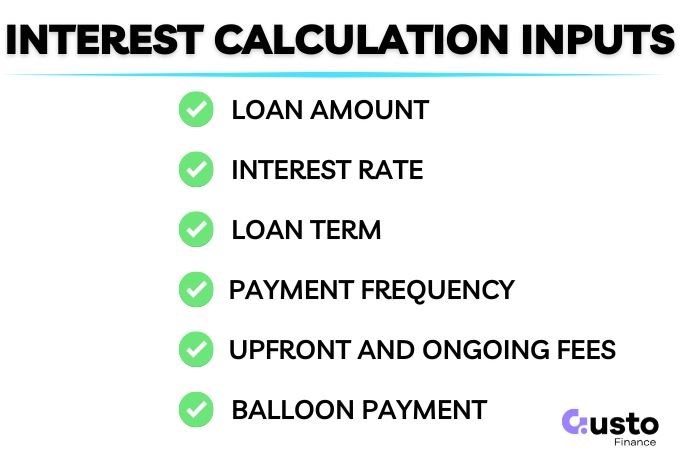
Before running any numbers, ensure you have these exact figures:
- Loan Principal
- Nominal Interest Rate (not the comparison rate).
- Loan Term and the total number of monthly payments (e.g. 5 years = 60 months).
- Establishment and ongoing fees.
- Balloon Payment, if applicable.
The last point is especially important.
A balloon payment essentially partitions a portion of your loan into an interest only component until the end of the repayment term.
Fixed or Variable Rates
The accuracy of your calculation will also depend on whether you will have a fixed or variable interest rate.
A Fixed Rate means your calculation remains accurate for the life of the loan.
A Variable Rate is only a snapshot. If the lender raises rates later, your repayment will increase regardless of your initial math.
Why Comparison Rates Are Irrelevant
Australian lenders must display a Comparison Rate to help you compare loan products.
This figure rolls the interest rate and associated fees into a single percentage.
However, you cannot use the comparison rate to calculate weekly repayments.
If you plug the comparison rate into a standard amortization formula, your result will be incorrect.
The correct approach is to use the Nominal Rate to calculate the interest repayment.
Then add the monthly cost of fees separately to find your true out-of-pocket cost.
Calculating the Reducing Balance
The reducing balance is the hard part of the interest calculation.
Unlike an interest only loan (that is more common with mortgages), interest charges apply only to what you currently owe.
This means your interest cost decreases every single month as you pay down the principal.
To check a specific month manually, find the Periodic Interest Rate, which is the annual rate divided by 12.
Then multiply it by the outstanding balance.
Example Monthly Interest Calculation
Consider a $20,000 loan at 5% p.a. with a $400 monthly repayment and no balloon payment.
Month 1
- Month 1 Interest: $20,000 x (0.05\12) = $83.33 Interest
- Principal Paid: $400 (repayment) – $83.33 (interest) = $316.67 Principal Paid
- New Balance: $20,000 – $316.67 = $19,683.33
Month 2
Repeat the same steps with your $19,683.33 balance as the starting point.
- Month 2 Interest: $19,683.33 x (0.05\12) = $82.01 Interest
- Principal Paid: $400 (repayment) – $82.01 (interest) = $319.99 Principal Paid
- New Balance: $19,683.33 – $319.99 = $19,363.34
While monthly figures are useful, the total interest cost determines the true value of the loan.
You can repeat this 60 times if you wan to calculate the total interest, but I would encourage you to instead check out our calculator page where you can achieve results in seconds.
Variables That Change the Total Cost
The example provided is very simple and does not include a number of common variables.
Monthly Fees
If your loan has a monthly fee, this will need to either increase the repayment amount to cover the fee or reduce the principal to keep the repayment consistent.
Daily vs. Monthly Interest
Most Australian auto lenders usually accrue interest daily but charge monthly.
Meaning charges fluctuate based on the number of days in the month.
As a result, your manual calculation will be close, but not not match the lender statement exactly.
Balloon Payments
A balloon payment is an interest only component of your balance and would need to be calculated as a separate input.
For example, if we assume a $5,000 balloon payment in the previous scenario then two separate interest calculations need to happen.
Month 1
- Month 1 Interest: $15,000 x (0.05\12) = $62.50 Interest
- Month 1 Balloon Interest: $5,000 x (0.05\12) = $20.83 Interest
- Principal Paid: $400 (repayment) – $83.33 (interest) = $316.67 Principal Paid
- New Balance: $20,000 – $316.67 = $19,683.33
Month 2
Repeat the same steps with your $19,683.33 balance as the starting point.
- Month 2 Interest: $14,683.33 x (0.05\12) = $61.18 Interest
- Month 2 Balloon Interest: $5,000 x (0.05\12) = $20.83 Interest
- Principal Paid: $400 (repayment) – $82.01 (interest) = $319.99 Principal Paid
- New Balance: $19,683.33 – $319.99 = $19,363.34
The interest only component (balloon payment) will incur higher interest over time, but in month 2 the difference is $0.0015.
Over the full five year term the additional interest cost will be $589, despite the miniscule change early in the loan term.
Frequently Asked Questions
Is car loan interest simple or compound?
Most car loans use a reducing balance calculation. Interest is charged on the specific amount you still owe each period. This means you pay less interest as the principal decreases over the life of the loan.
Why doesn’t my calculation of car loan interest match the lender?
Lenders accrue interest daily based on the exact number of days in the month, while manual formulas often assume a standard month. Small differences are standard due to rounding and payment timing.
Do I pay interest on a balloon payment?
Yes. The balloon payment represents money you have borrowed and not yet repaid. It accrues interest for the full term of the loan until you make that final lump sum payment or refinance.
Summary
Being able to calculate interest on your car loan is an important addition to your financial literacy.
The loan balance multiplied by your interest rate can give you a reasonable snapshot of your costs in any given year.
But if you want an accurate number you need to factor in the reductions in the principal over time.
You can skip over all manual calculations by getting in touch with our team of expert brokers who can instantly provide a range of scenarios that are within your budget.
