
While you can access variable rate car loans in Australia, the vast majority are fixed.
This is due to the market share held by non-bank lenders who specialise in various niches in the auto finance market.
They price their loan products carefully in proportion to the risk assessment of the customer.
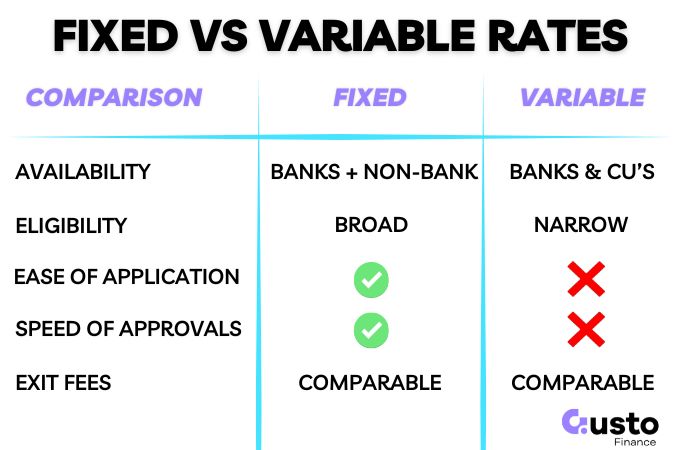
Most banks and credit unions offer a choice of variable or fixed rates, but they can be much harder to qualify for.
In this article, we will discuss the pros and cons of each interest rate structure, and also discuss what it takes to qualify for the lowest rates on the market.
Key Takeaways: Fixed vs Variable Rates
| Standard in Car Financing | The vast majority of car loans in Australia are Fixed Rate car loans. They are rarely offered outside of banks and credit unions. |
| Variable Rate Risk | The risk of large changes to your repayments is minimal. Even a movement of 1% will only have a moderate impact, depending on loan size. |
| Fixed Rate Duration | A fixed rate will remain in place for the life of the loan, it does not have an expiry date. |
| Accessibility | All auto finance lenders offer fixed rates, but only some offer variable. There are many more options to find a great deal with a fixed rate. |
Variable Rate Car Loans
The variable rates offered by banks are usually amongst the cheapest car loans on the market.
A lender’s funding costs, plus their margin, sets the rate. So if the funding costs increase, so will your interest rate.
The RBA’s official cash rate is one of the largest influences of this, but not the only one.
Your repayment amount can therefore rise or fall during the loan term. For this to be appealing, you would need to start your loan term with a lower rate vs a fixed interest option.
Whether it stays there depends on market conditions, creating a clear trade-off against the certainty of a fixed rate.
A variable rate car loan suits borrowers who want to save money, but can also absorb some repayment shock if rates are to rise significantly.
The risk can be managed by aggressively paying down the debt early in the loan term.
How to Qualify for a Variable Rate
In recent years, banks have reduced the amount of auto finance they are willing to lend.
As a result they are only willing to lend to the highest quality customers.
You may need a credit score above 800, and also be a property owner.
Credit unions may be slightly more relaxed, but not by much.
However, if you do qualify then you will be able to secure rates around the 6% to 8% mark.
Having said that, we regularly place customers in fixed rate loans at the same level with non-bank lenders.
Not only are they easier to qualify for, but their processing times are often much faster with same day approvals achievable in some cases.
So if you would like a free quote so you know your options before making an application clock below and the team will get to work.
Stress-Test Your Budget Against Rate Rises
If you prefer a variable rate then you will need to be certain that you can manage your repayments if they were to rise.
Having said that, a car loan is much smaller than a mortgage. So an interest rate change of 1% is unlikely to break the bank.
For example, on a $30,000 loan over five years, a 1% rate rise adds about $15 to your monthly repayment, while a 2% rise adds roughly $30.
So the risk is generally minimal.
Fixed Rate Car Loans
A fixed rate car loan locks in your interest rate and repayments for the entire loan term.
This provides complete budget certainty, as you know exactly what you will pay each month.
The key benefits include:
- Predictable budgeting with no surprise repayment increases.
- Protection from rising market interest rates.
This security comes at the cost of flexibility, a trade-off many borrowers underestimate.
Most fixed rate car loans include an early termination fee if you are to repay the loan in full before a set date.
You should check for this in your loan contract before signing so you know what the timeline is for this restriction, and what the penalty is for breaking it.
A fixed rate is ideal for borrowers who need predictable repayments for a tight budget and don’t plan to refinance or pay off the loan much earlier than the contracted day.
Sources of Fixed Rate Car Loans
It is far more common for a car loan contract to be set at a fixed rate.
You may have the choice of fixed or variable rates when applying to a bank or credit union, but most non-bank lenders will only offer a fixed rate.
Depending on your credit profile and the type of loan, we often see the fixed rates being comparable to the lowest variable rates offered by the big banks.
Unless you are expecting interest rates to fall significantly it usually makes sense to lock in the lower rate for the life of your loan.
Interest Rate Transparency
Lenders like to advertise a rate that grabs your attention the most. Whether you can qualify for that rate is one thing, but the associated fees is another.
Whether you are considering a fixed or variable rate loan, make sure you also check the comparison rate.
This gives you a snapshot of the true cost of the loan for easier comparison.
However, it doesn’t compare the loan you want so it is just a tool for you to reference an not a deciding factor.
Do Split Rate Car Loans Exist?
Split rates are more common in mortgage lending, but not in auto finance.
You cannot elect to have a portion of your car loan under a fixed rate, and the remainder as a variable.
Given the smaller potential variations in your repayment under a variable rate loan this is just unnecessary with car financing.
Frequently Asked Questions
Are most car loan rates fixed or variable in Australia?
Both fixed and variable rate car loans are available in Australia, but fixed rate loans are far more common.
Does the fixed rate last the full loan term?
A fixed rate car loan will stay that way for the duration of the repayment term. This ensures fixed repayments until the principal has been repaid in full.
Can I refinance a fixed-rate car loan early?
You can refinance a fixed-rate car loan at any time. However, you may be liable for an exit fee if you payout the loan within a fixed period of time. This is usually a few hundred dollars for a consumer loan, but could be in the thousands for a commercial loan.
Fixed vs Variable Car Loan Rates
Unless a variable rate is going to save you a significant amount of money, it is rarely worth it considering the uncertainty of your repayments.
A fixed rate offers budget stability but penalises early payouts. A variable rate lets you clear debt faster, but your repayments can rise with the market.
To make the right choice, take these steps:
- Stress-test your budget by calculating repayments with a 1-2% rate increase.
- Compare multiple lenders to choose the best loan structure, not just a headline rate.
- Get pre-qualified so you know where you can source your car loan.
You can fast track the market comparison and get a preliminary assessment of the best lender for you by getting in touch below.
