
Adding a co-borrower to your car loan application seems like a simple way to strengthen your application and improve your chance of approval.
But this is a serious legal commitment for both parties.
Lenders view both applicants as equally responsible for the entire debt, creating significant risks if not thoroughly understood.
In this article, we will discuss how to qualify as a co-borrower on a car loan, what your obligations are, and the concept of beneficial ownership.
Key Takeaways: Co-Borrower Auto Finance
| Equal Responsibility and Ownership | Unlike a guarantor, a co-borrower is 100% equally responsible for the debt. Both names go on the loan. |
| Beneficial Interest in Vehicle | Lenders require that both parties will genuinely benefit from ownership of the car to qualify for a joint car loan. |
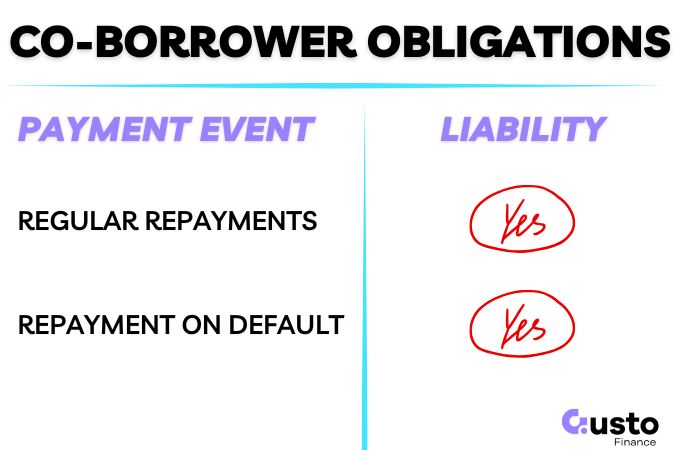
| Repayment Risk | If one person stops paying their share, the other is legally liable for the full amount. Any private repayment agreements are irrelevant to the loan contract. |
| Credit File Risk | A default or missed payment will damage the credit history of both borrowers. |
Difference Between a Co-Borrower, Co-Signer, and Guarantor
What is a Co-borrower
A co-borrower and co-signer are terms used for the same thing. A joint applicant where both parties share full responsibility for the loan.
Lenders assess both incomes and credit histories together to determine eligibility.
Both parties are jointly liable for the entire debt, and have equal ownership rights.
You should choose a co-borrower structure if you intend to share use of the vehicle, and the repayment responsibility.
What is a Guarantor
A guarantor acts as a financial backstop. They guarantee repayments if the primary borrower defaults but have no inherent right to use the vehicle.
The guarantor’s name is not on the car’s registration, so they have no ownership rights.
Only the financial obligation if the primary borrower defaults on the loan.
Guarantor loans are very rare in Australia due to regulatory challenges.
However, if you pursue this option it is most suitable where one person is comfortable providing financial support to help the other get approved.

Should You Apply with a Co-Borrower
It is most beneficial to borrow with a co-borrower when both parties live together and will use the vehicle, both have a similar quality credit history, and ideally have a shared household budget.
There are far more scenarios where you should not make a joint application.
For example:
- One borrower has a very high credit score, and the other is very low. Product eligibility will revert to the lower score of the two.
- One borrower cannot commit to the full repayment term (usually 5-7 years).
- Both parties will not genuinely benefit from owning the vehicle.
If you are considering a co-borrower just so you can use their income to access a larger loan amount, then this may not be necessary.
It is very common to use the household income for couples when assessing their capacity to service a loan without both being party to the loan.
If you would like some guidance on what structure would best suit your circumstances then click below to get in touch with the team.
What Lenders Check on a Joint Car Loan Application
Lenders don’t average your two profiles into one. Instead, they conduct two full assessments and then price the combined risk.
Both credit files are pulled to review repayment history, defaults, and recent enquiries.
While a stronger file can help secure a lower interest rate, it won’t erase serious issues like a recent default on the weaker profile.
For serviceability, lenders pool your total combined income and measure it against your total combined monthly expenses to determine your borrowing power.
Lenders also assess stability signals for both applicants, including consistent employment (favouring permanent roles) and a stable residential history.
Before applying, run this quick self-check:
- Add up both incomes.
- List all recurring expenses.
- Stress-test repayments at a higher interest rate to ensure it’s truly affordable.
Given that both parties will be liable, a lender will also want to know more about how the vehicle will be used and the justification for both parties being liable.
Proving Beneficial Interest
Lenders require a genuine reason for your joint application. This principle is called establishing beneficial interest.
Both co-borrowers must genuinely benefit from owning or using the car.
This proves the partnership is legitimate, not just a tactic to achieve finance approval.
It is also a safeguard against one party taking advantage of another who may be vulnerable to financial abuse, or coercive control.
Some common scenarios include partners sharing a household vehicle, or a parent helping a child who also contributes to running costs.
Red flags are raised if one applicant has no clear connection to the vehicle’s use, control, or insurance.
Applicants that do not share an address are of particular concern and could indicate that the co-borrower is not likely to benefit from the vehicle.
It could be a sign that one person is simply lending their credit profile to mask risk, which will lead to rejection.
A good broker will pre-empt this question and provide the context for each borrower alongside the application so there are no holdups later in the process.
What if the Co-Borrower Doesn’t Drive?
In some cases, a co-borrower may be a financial contributor to a car but has no driver’s licence.
A license determines who can legally operate the vehicle, not who can have a financial stake.
However, the lender will question this and a broker can provide the required context to ensure the arrangement is above board.
The Joint Application Document Checklist
A joint application requires both parties to provide comprehensive documentation.
If either co-borrower cannot provide all that is required it will slow the approval process, and potentially lead to rejection.
Gather everything upfront to ensure a smooth, fast, approval.
Credit Profile of Both Applicants
Both applicants will need to have a credit score above the minimum threshold for the car loan product they are applying for.
If one has a very high score, and a very low score, the application would be placed with a lender who will accommodate the lower of the two scores.
However, if there is a large disparity between each party then a co-borrowing arrangement will lead to a poor outcome and would not be recommended by our team.
Documents for Each Co-Borrower
- Photo ID: A valid driver’s licence.
- Proof of Address: A recent utility bill, lease, or mortgage statement.
- Proof of Income: Recent payslips for employees.
- Existing Debts: Loan or account statements, if requested by the lender.
Documents for the Vehicle
- Sale Details: A dealer invoice or private seller’s vehicle information.
- Deposit (if applicable): Proof of funds if you are contributing a deposit.
- Insurance: A Certificate of Currency is required before settlement.
Contract Signing and Private Agreements
Both parties will be required to sign the contract. It is important that both parties read the full agreement and understand what they are signing.
If there is a private agreement for how the repayments will be split, this is between the borrowers and does not involve the lender.
If one borrower does not uphold their side of the agreement then the other is liable for the full loan repayments.
Failing to do this will lead to default on the finance contract, damage to the credit score of both parties, and potentially the vehicle being repossessed.
If one party wishes to pursue the other for missed payments then this is a private matter not involving the lender in any capacity .
Can a Co-borrower Exit the Contract
Your main exit options are refinancing the car loan into one name or selling the car to pay the lender.
Simply transferring the car’s ownership does not remove your loan liability. The lender must formally release you by closing or refinancing the loan.
If you ever feel controlled, seek confidential support from independent legal or financial services.
Frequently Asked Questions
Does adding a co-borrower guarantee loan approval?
A co-borrower does not guarantee approval. Both applicants will be assessed fully and any significant negative credit issues from either party can lead to a rejection.
Will the car loan show on both credit files and affect both scores?
A joint car loan will show up on both credit files. Co-borrowers are equally liable for the debt, so the loan is reported on both credit files.
Do both co-borrowers have to be on the car’s registration?
In some states, a car can only be registered in one name. So both co-borrowers cannot be on the car’s registration in those states. Only the primary user of the vehicle.
Can a co-borrower be removed from a car loan later?
A co-borrower can only be removed by refinancing the car loan into a single person’s name, provided they qualify on their own. Simply transferring the ownership is not enough to remove their financial obligation.
Is a Joint Car Loan Your Best Option?
Applying with a co-borrower means equal legal responsibility and should only be considered in specific circumstances.
Often, we can achieve the same result in terms of application strength without the contractual restrictions that come with a co-borrower arrangement.
However, many couples prefer this arrangement and it works perfectly well for most.
Just consider the risks associated with this arrangement before committing.
Lenders assess both profiles and require a genuine beneficial interest.
For a free assessment on what you best options are you can start a quick online application below.
