
Electric vehicles are cheaper to run day-to-day, but can involve a number of trade-offs in convenience and future asset values.
If you are financing your EV you may qualify for interest rate discounts, and in some states even lower rego costs.
But there is much more to consider when assessing the cost of ownership and the practicalities of driving and maintaining an EV.
In this article, we will discuss how to assess if an EV is right for you. From financing your new car to some of the pitfalls of ownership you may not have considered.
Key Takeaways: Buying an EV
| Green Loan Discounts | Many lenders offer discounted interest rates specifically for Electric Vehicles (EVs) and Plug-in Hybrids (PHEVs) to encourage sustainable driving. |
| Novated Lease Benefits | If your employer offers salary packaging, an EV on a novated lease can benefit from Fringe Benefits Tax (FBT) exemptions. |
| Depreciation Risk | EV battery technology is advancing rapidly and current models may depreciate faster than petrol cars. |
| Bundle your Charger | Some lenders allow you to roll the cost of purchasing and installing a home EV charger directly into your car loan. |
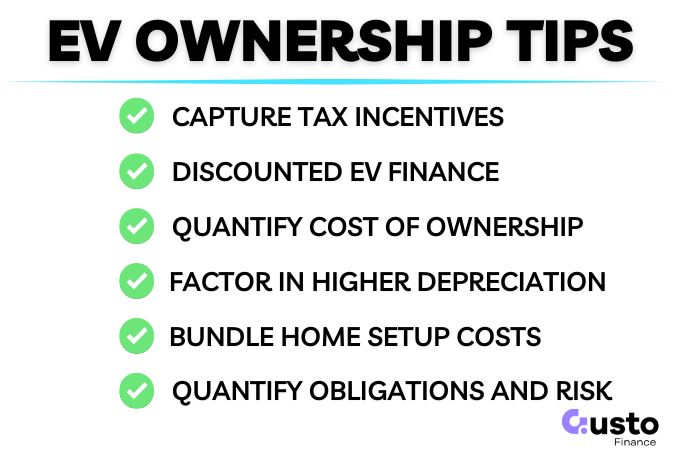
6 Tips When Buying (and Financing) an EV
1. EV Finance Options
There are tax incentives offered on EV finance products that can lead to big savings.
The finance structures are the same as buying a regular vehicle, but with added discounts or tax breaks.
- Secured Green Car Loan: Uses your EV as collateral to reduce lender risk, delivering low rates, with a green car discount.
- Novated Lease: Leverages salary packaging if offered by your employer. This is effective for eligible EVs due to specific Fringe Benefits Tax (FBT) exemptions.
The best option for you will depend on your tax bracket, target vehicle, and eligibility for each incentive.
In the case of a novated lease, you would need to be a PAYG employee and offered within your employer’s salary packaging policies.
2. Comparing EV Loan Discounts
Discounted rates for a green car loan exist, but they are not universal and often come with strict vehicle and age conditions.
Eligibility can be restricted to:
- Battery electric vehicles (EVs)
- Plug-in hybrid electric vehicles (PHEVs)
- Conventional hybrid vehicles
- Hydrogen fuel-cell vehicles
- Other Low-emission that fall below a lender’s CO₂ threshold
- Flashy marketing hides the reality that past financial hurdles or lender fees can easily lock you out of these offers.
It is important that discount eligibility is confirmed prior to applying for the loan so you know your cost of finance upfront.
3. EV Cost of Ownership
In addition to the discount eligibility, you still also need to be approved for your loan under the regular credit policies of the lender.
This means proving that you can repay the loan and that the cost of ownership and finance is within your household budget.
However, some of the usual car costs will vary compared to a regular petrol vehicle. You should estimate the following prior to purchasing an EV:
- EV insurance premiums: Policies can be higher than those for standard vehicles.
- Charging costs: Increased home electricity bills and the variable fees of public fast charging (still cheaper than petrol!)
- Registration and stamp duty: some states have discounted stamp duty rates but larger incentives have generally expired.
You should now have a good understanding of the savings you can make by choosing an EV, and if it is viable to finance the purchase. .
4. EV Depreciation (and Balloon Payment Risks)
The rapid pace of EV technology updates means that the second-hand market is unpredictable.
Changes in demand will directly impact future resale values.
While there is no certainty, you should consider depreciation rates for similar models already in the market so you have an understanding of your asset value over time.
If you are planning to use a balloon payment in your EV car loan structure then this is even more important.
You may want to limit the size of your balloon to minimise end-of-term risk.
5. Bundle Your EV Charger and Setup Costs
If you are planning to install a home charger for your EV, some lenders allow you to add this to your car loan.
This allows you to bundle up all of your setup and purchasing costs into the one facility.
Being able to charge your vehicle overnight make EV ownership far more convenient than if you are using public charging stations.
6. Assess EV Ownership Risks Before Buying
A cheap finance deal is irrelevant if daily ownership friction forces you to exit your loan early at a loss.
Before applying, assess how the vehicle impacts your budget, resale value, and insurability so it is sustainable for the life of the loan.
Assess the commitment you are making by checking the following practicalities when using your new EV:
- Battery Warranties: Confirm the exact warranty terms, remaining coverage, and if the protection legally transfers to the next owner.
- Charging Access: Map your regular driving patterns against home, workplace, and recreation charging costs and availability.
- Qualified Servicing: Verify local access to specialized EV mechanics and if you are obliged to use a specific service centre.
Frequently Asked Questions
Can I get a lower interest rate for an EV
Some lenders offer green discounts based on the vehicle and your credit profile. You should assess if your target vehicle qualifies prior to applying for the loan to ensure you secure the discounted rate.
Can I finance a home charger for my EV?
Some lenders do let you bundle charging equipment and installation costs into your EV loan. Ask upfront what is permitted so you can see if quotes fall within the allowable budget.
Get The Right EV Finance Strategy
Avoid expensive mistakes by choosing the right finance structure, comparing total loan costs, and setting an all-in budget.
While the overall cost of ownership should decrease, the benefit of this depends largely on your intended usages.
Higher depreciation can offset the day to day cost savings if you do not drive regularly.
However, there are some great finance deals available for EVs in a market that is constantly changing.
Get in touch with our expert team below to discuss your options.
