
A car loan is a long term commitment with repayments to be made over a 5-7 year period in most cases.
But what if your financial situation changes within that time?
You may need to make some cuts to your household budget just to get by.
In this article, we will share strategies to reduce your car loan repayments so you can stay on top of things and avoid a costly default.
Key Takeaways: Lowering Repayments
| Costs May Increase | If you lower your repayments by extending the time to repay your costs will increase unless you refinance to a better rate to offset the cost. |
| Principal Reduction | By making extra repayments you create a buffer that may allow you to lower your repayments and still pay within the original timeframe. |
| Use Balloons Wisely | Balloon payments can reduce the repayments significantly but can introduce extra risk. |
| Hardship as a Last Resort | Lenders are obligated to extend flexible repayment options where you can demonstrate significant financial hardship. |
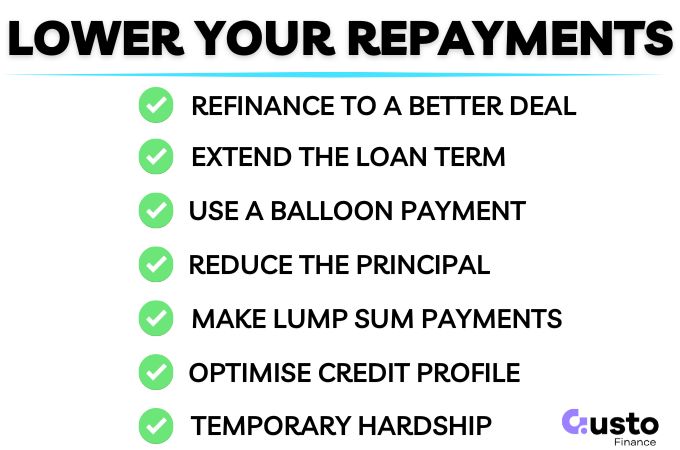
7 Ways to Lower Your Car Loan Repayments
1. Refinancing Your Car Loan
High repayments are often the result of an uncompetitive interest rate.
Perhaps you had poor credit at the time you applied, or maybe you just signed a dud deal when you could have done better.
The good news is that you can refinance into a better deal!
But this requires careful calculation of all exit and setup costs to ensure you are making genuine savings.
Before starting, obtain a formal payout figure from your lender for a specific settlement date.
Never estimate this amount as you could miss any additional fees that need to be covered.
Then compare the market quickly using a broker, and assess your current credit profile against what rates are available to you.
Accessing a Better Deal
In order to access a better car loan deal one of the following needs to be true:
- Improving Credit Score (See No. 6 for some tips on how)
- Change in loan market conditions
A common scenario that we deal with is moving someone from a bad credit loan that could have a rate of 15% to 20%.
They have made all their repayments and their credit score is improving, and they can now access a rate of 12% or lower.
The other is when there is increased competition in the market, or there are general interest rate cuts.
Moving from an 8% rate to 6% finance can mean big savings over the life of a loan.
Watch Out for the Refinancing Traps
Focusing only on the new interest rate without factoring in fees is a common mistake that can eliminate perceived savings.
You will need to check the following potential costs:
- Exit Fees: If your existing lender charges a fee to close the account.
- Establishment Fees: The new lender will charge a fee to set up the new loan.
A small rate drop can reduce total interest significantly, but only if the projected savings clearly outweigh the cumulative fees.
Our brokers will always quantify the following to ensure you will be better off. Click below for an obligation free quote.
2. Extending the Loan Term
If monthly cash flow is tight, extending your loan term is the simplest route to immediate payment relief.
Spreading the principal over a longer period lowers the required monthly repayments.
The trade-off is that you are going to pay additional interest over the life of the loan.
Extended Loan Term Example
A $30,000 loan (8%) over four years costs $5,160 in total interest.
Extending the term to seven years reduces the monthly payment by $180, but increases total interest paid to $9,075.
Nearly double the original cost!
If you qualify for refinancing you may be able to get a better rate, while also extending the repayment term.
This can offset some of the extra costs.
Check out our car loan refinance calculator to compare your potential savings.
3. Use a Balloon Payment
You can achieve materially lower repayments without changing the interest rate or loan term, by adding balloon payment.
This tactic involves reducing monthly principal payments, leaving a significant lump sum (the residual value) due at the contract’s end.
This structure makes sense for tighter cash flow management (especially in business vehicle finance) or if you plan to sell or trade-in the vehicle before the term ends.
However, you must consider the risks of this approach.
If you do not have savings to cover the balloon payment at the end of the term you will have to either refinance or sell the vehicle.
If the vehicle’s market or trade-in value is less than the required balloon amount at term end, you may be in a tricky spot.
A balloon only lowers car loan repayments now by pushing that cost until later. Treat it as a planned future transaction, not a free discount.
4. Reduce the Principal
The cleanest strategy to reduce repayments is to lower the loan principal before applying.
This could mean buying a cheaper car, but this can be the most prudent move for some.
Your options to reduce the principal are:
- Increase Your Deposit: Even small additions reduce the financed debt and immediately lower monthly payments.
- Optimising Trade-In Value: Ensure your used vehicle is detailed and has up-to-date service history to maximize the trade-in credit.
- Select the Right Vehicle for your budget: Opt for a cheaper trim level or skip expensive, financed add-ons.
Lenders love this approach; a lower Loan-to-Value Ratio (LVR) signals reduced risk, often improving your interest rate and certainty of approval.
This principal reduction remains the most effective lever for both consumers and ABN holders.
5. Make Lump Sum Car Loan Repayments
Directing any surplus cash (tax refunds, bonuses) to extra payments, is the fastest way to reduce your total interest cost and shorten the loan term.
If you are ahead of schedule you may also be able to lower your minimum car loan repayment if the lender agrees.
However, if you don’t do this then the accelerated debt reduction provides significant long-term savings.
You can also achieve this by rounding up your regular repayments (e.g., $385 to $400 monthly) and chipping away at the principal over time.
6. Optimise Your Credit Profile for the Lowest Interest Rate
High interest rates are a direct result of a perceived high-risk credit profile.
Optimising your financial standing is essential to securing competitive pricing and lowering monthly repayments.
Execute these quick administrative wins immediately:
- Avoid New Credit Enquiries: Do not apply for any new debt (credit cards or loans) in the 3-6 months leading up to your car finance application.
- Fix Your Credit Report: Ensure any arrears or defaults have been repaid in full as soon as you are able.
- Clean Bank Statements: Eliminate patterns of high-risk spending, such as gambling or frequent short-term borrowing/cash advances, from your transaction history.
A low-risk profile guarantees access to the most competitive rate options.
7. Temporary Hardship Reduction
If you are facing financial hardship due to job loss, illness, or unexpected expenses then you should contact your lender immediately.
The National Credit Code gives you the legal right to submit a hardship notice requesting a temporary change to your car loan contract.
This can lower, or stop, your repayments for a limited period of time and can be a lifesaver if you cannot afford your car loan.
However, you should note that hardship arrangements could be listed on your credit file for up to 12 months.
While this may sound restrictive, it is much better than a falling into arrears (2 years) or defaulting (5 years).
Some options you can request from your leander include:
- Payment Deferral: Request a 30 to 90-day pause on all payments.
- Reduced Repayments: Pay only what is genuinely affordable for a fixed period (e.g., six months).
- Interest-Only Period: Pause principal payments while covering the interest component for a set duration.
- Term Extension: Permanently lower repayments by extending the loan term.
Frequently Asked Questions
Will extending my loan term hurt me long-term?
While extending the loan term provides immediate cash flow relief by lowering monthly payments, it will increases the total interest cost over the life of the agreement. The amount of hurt you experience depend on how long you extend the term for.
Do extra repayments reduce my required minimum monthly repayment?
No, generally, extra repayments reduce the outstanding principal balance and shorten the loan term, thus reducing total interest paid. They do not automatically lower your scheduled minimum repayment unless you formally request a restructure of the loan with your lender.
What happens if I miss car loan repayments or stop paying?
Missing repayments triggers fees, damages your credit score, and makes future financing significantly harder. Since car loans are secured, sustained non-payment increases your risk of repossession. All are to be avoided wherever possible.
When Should You Lower Your Car Loan Repayments
Unless you are refinancing to a better deal, and reduction in your car loan repayments is going to cost you more money over the long term.
So wherever possible you should maintain your repayments, and if you come into extra money, to pay extra.
However, this is not always possible.
Managing your debt proactively so you do not fall into arrears is critical to preserve your future credit opportunities.
No matter what short term difficulties you face there is a way to manage them if you work through this list.
