
A boat loan generally functions in a similar way to any other type of secured asset finance.
You are assessed on whether you can comfortably make your loan repayments, and whether the asset is of sufficient value and quality to be held a security over the loan.
Where marine lenders may differ from a car lender, for example, is the heightened scrutiny on the asset’s condition, vessel age, and the risks associated with private sales.
In this article, we will discuss how boat finance works, what lenders look for, and how to structure your loan for the best result.
Secured vs Unsecured Boat Finance
Given the huge difference in boat quality out there, the first question is whether secured finance is an option at all.
Buying an old tinnie to use on the weekends is not in the same ballpark as a modern cuddy cabin with a much higher ticket price.
However, the cost of finance and borrowing power will differ depending on the type of loan you qualify for.
Secured Boat Loan
The lender registers a formal interest over the boat, using it as collateral.
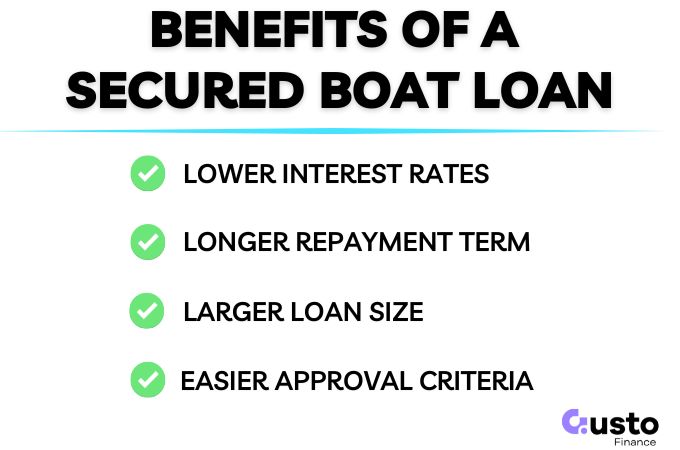
Because this lowers the lender’s risk, it unlocks lower interest rates, higher borrowing limits, and longer repayment terms (typically 1 to 7 years).
Each lender will have criteria on what is eligible to be held as security, and what is not. If your target boat is not eligible your only option could be unsecured.
Unsecured Loans
This works like a standard personal loan with no asset attached.
While you will face slightly higher rates and lower borrowing limits, the team at Gusto Finance can secure some exceptional finance options if you have a decent credit score.
The advantage of this option is you have total freedom over how you spend the funds. This means you can opt to direct some of the money towards:
- Older vessels
- Engine upgrades
- Fishing gear
- Electronics
If you are buying an older boat that falls outside standard criteria, your options narrow, and lenders may require an unsecured loan or a larger upfront deposit.
For those with bad credit, you may still be able to access a cash loan to buy a boat but this is at a much higher cost and lower limit.
In this scenario, the tinnie may have to do.
How Lenders Assess Your Boat Loan Application
When a lender reviews your application, they are looking at two distinct buckets: Your profile and the quality of the boat.
1. Assessing Your Credit Profile
Lenders will assess your capacity to repay the loan in addition to your existing financial commitments.
To do this, they will consider your:
- Stability of your income
- Living expenses
- Existing debts
After calculating all of this there must be a sufficient surplus to ensure you can comfortably service the loan.
Your credit history will also be an important factor.
If you have unpaid defaults, arrears on other loans, or any other adverse credit event you may find it harder to get approved.
2. Assessing The Boat
Lenders closely evaluate the vessel’s type, condition, market value, and age.
- The Asset Age: Vessel age is a common hidden hurdle. Lenders enforce strict cutoffs based on a boat’s age at the end of the loan term. Choosing an older boat can immediately restrict your maximum repayment term and increase your monthly instalments.
- Marine Surveys: For older or high-value vessels, lenders often require a formal marine survey to verify the boat’s condition. Treat this as an upfront cost and factor it into your timeline to avoid settlement delays.
Structuring Your Loan: Rates and Balloon Payments
Advertised headline rates can be misleading as most lenders use risk-based pricing.
This means your actual cost changes based on your credit profile, loan term, and lender fees.
While the Comparison Rate can help you compare lenders quickly, it does not account for how each lender will assess your specific risk profile.
This is why it can save you significant time and money by using a broker.
They can compare the market and match you with the lenders who are most likely to approve your loan, with the best rates that you qualify for.
Should you use a Balloon Payment?
A balloon payment allows you to commit to lower regular monthly instalments in exchange for paying a large lump sum at the end of the loan.
- The Benefit: It improves your borrowing serviceability on paper today and keeps your monthly overhead low.
- The Risk: It increases the total interest paid over the life of the loan and raises your refinancing risk if the boat depreciates faster than expected.
These work well if you are planning to sell or upgrade your boat at the end of your loan term.
If not, you can still refinance the balloon amount subject to a future credit assessment.
The 4-Step Boat Loan Process
A fast timeline ensures you never lose your dream boat to another buyer.
Follow these four steps to reach settlement quickly:
- Pre-approval: Establish your maximum budget and get your finances checked before you start shopping.
- Find the Boat: Negotiate your purchase price. If buying privately, physically locate the Hull Identification Number (HIN) and run a Personal Property Securities Register (PPSR) search to ensure there is no outstanding debt on the vessel.
- Formal Approval: Submit the purchase contract, HIN, and any requested marine surveys or valuations to the lender.
- Settlement: Sign the loan contract and provide proof of comprehensive marine insurance. The lender will then pay the dealership or private seller directly to eliminate fraud risk.
Our team of brokers can ensure that you move through this process quickly.
Frequently Asked Questions
Can I get a boat loan with bad credit?
Yes. Specialist lenders offer second-chance boat loans, though you should expect higher interest rates. Approval relies heavily on your current financial stability, clean bank conduct, and a realistic loan size.
Do I need a deposit for a boat loan?
Not always. However, contributing cash improves your approval odds, can lower your interest rate, and helps significantly when buying older vessels or purchasing privately.
Can the loan cover extras like trailers or fishing gear?
Unsecured loans offer total freedom to fund accessories. For secured finance, adding electronics or trailers depends entirely on the lender’s specific Loan-to-Value Ratio (LVR) policy.
What if I am buying for business use?
If you hold an ABN, specialist commercial finance is available. Always consult your accountant regarding tax deductions and GST treatment.
Next Steps for Your Boat Finance
Whether you are eyeing off a weekend tinnie or upgrading to a modern cuddy cabin, getting the right finance shouldn’t be a guessing game.
As we’ve covered, your choice between a secured and unsecured loan, the age of your vessel, and your unique credit profile will all dictate your final rate and borrowing power.
Navigating risk-based pricing, marine surveys, and strict lender criteria takes time.
Instead of trying to compare complex policies on your own, let our team do the heavy lifting to match you with the right loan structure.
Speak to a Gusto Finance broker today to find your exact lender fit and get out on the water faster.
