
The usual objective of trading in a car is a quick and easy sale where surplus funds contribute to the purchase of your next vehicle.
A dealership may offer more favourable terms if they can also have the chance to make a return on the trade-in.
If you have finance owing on the trade-in then any surplus will be depending on what you still owe.
If the value of the trade-in is less than the loan amount you may be left out of pocket.
In this article, we will cover the necessary calculations and research you must do so you are not left short.
Key Takeaways: Trade-In with Car Loan
| How Does a Trade-in Work with Finance? | When trading in a car with a loan the dealer will pay off the old loan directly to the lender, and handle the security release for you. |
| Get a Payout Quote | Do not guess. You need a formal payout letter from your lender (valid for 7–14 days) to know exactly how much must be paid to clear the debt. |
| Calculate Your Equity | It is a simple calculation of Trade-in value – Payout figure = Net Equity. A surplus will go towards the next car purchase. |
| Negotiate the Trade-in | Negotiations will include both the trade-in value, and the purchase price of the new car. Use both to get a better deal. |
Preparation Before Going to the Dealership
Get an Official Payout Letter
While the maths is simple, you need to make sure your figures are accurate.
Your payout figure may be different to the outstanding balance and you will need to contact your lender for this.
A precise amount will be calculated to finalise the debt on a specific date.
This will include your principal plus accrued interest, discharge fees, and early termination charges (if applicable).
Because interest accrues daily, these quotes are time-sensitive and often expire within 7 days.
You must also check if a scheduled direct debit is due before settlement, as this will alter the final calculation.
Before you head to the dealership to negotiate your trade-in you should request a formal payout letter in writing that confirms:
- The total payout amount including all fees
- The specific valid until date
- Payment details for the dealer
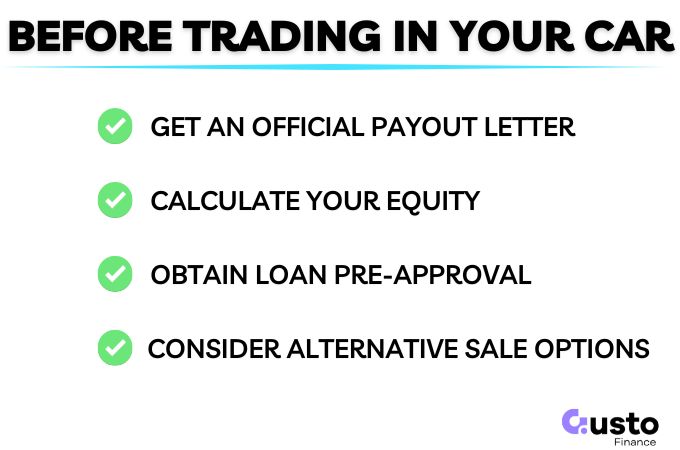
Calculating Your Equity Position
Calculate your equity before visiting a dealership to prevent negotiation surprises.
All you need to do is subtract your current loan payout figure from the car’s estimated trade-in value.
For example, if you are offered $20,000 for your trade-in and have a payout figure of $15,000, the surplus will be $5,000.
The dealer uses this surplus as a deposit on your next purchase, reducing the total loan amount and your future repayments.
Trade-in vs Private Sale Value
When estimating your trade-in value, you must be conservative.
Trade-in offers are at wholesale prices and will be significantly lower than comparable private sale listings you may find online.
Expect any offer to be at least 10-15% below this, and sometimes more.
The dealership will refurbish the vehicle and on-sell it, so there needs to be a sufficient margin in it for them to consider doing so.
If a higher sale price is a priority for you then you can try and sell the vehicle yourself privately.
However, there could be listing costs to sell online and the inevitable frustration and wasted time from dealing with potential buyers.
Get Loan Pre-Approval
A dealership is going to try and push you into finance when on-site and the solutions available can be limited.
If you want to find the best car loan for your circumstances then a broker can look at the market and match you with the right lender for your credit profile.
Our expert team has access to over 50 lenders and can give you a quote in seconds, and organise same day pre-approval.
Get in touch below to speak to the team.
Guide to Trading in a Car Under Finance
Now that you have all of your documents and a reasonable idea what the offer could be, you are ready to head to the dealership.
Trade-In Offer
The dealership will inspect the vehicle, take it for a quick test drive, and then name a figure.
It will probably be at the lower end of your estimates and you should negotiate until you reach a figure you are happy with.
There are usually trade-offs that can be made between the value of the trade-in and the cost of the new vehicle you are buying.
Once you are happy with the combined outcome then the dealership can drive most of the process from here.
Settlement of Existing Loan
Assuming you are equipped with your payout letter all you need to do is hand this over to the dealership for processing.
They will pay your lender directly to settle the loan and set aside any surplus to go towards the deposit on your next vehicle.
The outcome depends on the valuation:
However, if there is a shortfall you will have to cover the gap either with cash, or roll it into your new car loan.
This is not always possible though due to the high loan-to-value ratio, and it will be costly over the long term.
Make sure you carefully look over a written invoice before signing.
It should list the trade-in offer, the exact payout amount, and the final changeover price.
Security Over Trade-in Vehicle Released
Once your current lender receives the settlement payment they will remove the encumbrance over the vehicle.
This is listed on the Personal Property Securities Register (PPSR) and can usually be removed quickly.
If your dealership is paying the settlement then this is less likely to delay the transaction being completed.
Alternatives to Trading in Your Financed Vehicle
Trade-ins are the most convenient option, and makes sense for those who just don’t have the time to invest in a sales process.
But they will not yield the best financial outcome.
If you need to squeeze every dollar out of the sale you could also consider:
- Selling privately to maximise the price. This has the highest price potential but the administrative burden is high. You may also need a roadworthy certificate prior to the sale.
- You can also explore a car buying service. While they will also need a lower price so the car is worth their time, it may be helpful to compare an offer vs your trade-in value.
Your decision may be influenced most by your expected equity position and whether you have a shortfall to cover or not.
Frequently Asked Questions
Can I trade in my car if it carries secured finance?
Yes, provided the lender is paid out to release the security interest. The dealership typically facilitates this during settlement by paying the payout figure directly to your lender and transferring the remaining surplus (or requiring a gap payment) to finalise the deal.
How do I determine if I have negative equity before visiting a dealership?
Subtract your official payout figure from a conservative trade-in estimate. Obtain a written payout letter from your lender, then research the wholesale value of your car. If the payout amount is higher than the car’s value, you are in negative equity and must plan how to pay the gap.
What documents must I bring to trade in a financed vehicle?
You need a valid payout letter from your lender, your loan account details, vehicle registration papers, and 100 points of ID.
Checklist for Trading in a Vehicle with Finance
It is very common for cars to be traded in while still under finance and all dealerships will be able to manage the transaction without an issue.
You can minimise any surprises on the day by following this checklist:
- Get an official payout letter from your current lender.
- Estimate your trade-in value.
- Calculate your net cash outcome.
- Negotiate the trade-in price (and purchase price of new car).
- Check invoice and provide payout letter.
- Let the dealership take care of the admin from there.
You may even be able to drive away in your new car that day.
If you need some help doing the sums on your equity position, and seeking pre-approval for your new car loan then get in touch with our expert team today.
